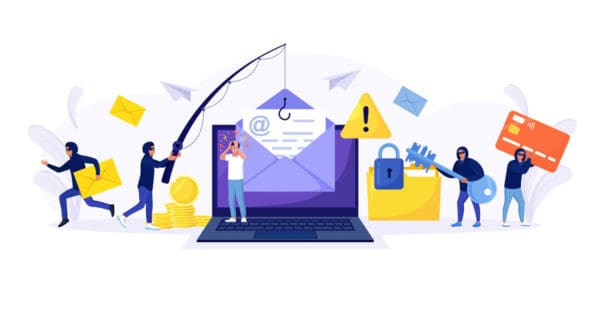
When looking at the cyber attack risks that businesses face today, phishing tops the chart. It’s a problem that also just keeps getting worse – 84% of businesses in a new study said that they were the victims of a successful phishing attack in 2021, a 15% increase over the same 12-month period in 2020. Phishing attacks are also growing more sophisticated thanks in part to abundant dark web data that helps the bad guys shape effective campaigns. Unfortunately, the other end of that equation is often compounded by the behavior of employees when handling email.
1. Human Error is Always a Variable
Human error is the culprit in an estimated 90% of security breaches according to IBM’s X-Force Threat Intelligence Index. Those errors can range from sending a coworker a file they’re not authorized to see to downloading a malicious attachment from a phishing email. One-fifth of employees admit to making mistakes like falling for phishing tricks that caused them to interact with malicious messages at work – and these seven risk factors can impact employee behavior around phishing.
2. Employees Can Easily Fall for Bad Attachments
Employees are regularly faced with convincing phishing schemes that utilize attachments, and the bad guys are very good at creating attachments that are highly believable. An estimated 48% of malicious email attachments are disguised as a routine file, running the gamut from a termination notice to a list of charitable resources. This was recently illustrated by a flood of phishing around charitable relief for Ukrainians in the wake of the Russian invasion.
3. Social Engineering Keeps Growing More Sophisticated
Phishing is hands down the cheapest, easiest and most effective way to penetrate a company’s security, and social engineering is a big part of what makes it so dangerous. Of course, it’s also something that evolves just like any other business process. That means that today’s threats are much more sophisticated than yesterday’s and unfortunately that has resulted in 97% of employees being unable to spot a sophisticated phishing email.
4. People Love to Click Links
Far too many employees are not judicious about clicking links in email messages. CyberNews reports that 1 in 3 employees are likely to click the links in phishing emails, and 1 in 8 employees are likely to share information requested in a phishing email. Even more alarmingly, 67% of the employees tested in a phishing simulation who clicked through to the dummy malicious website submitted their login credentials, up from a scant 2% in 2019. Preventing these links from reaching employees is critical for security success.
5. A Weak Security Culture is a Disaster
Security is everyone’s job, but not everyone understands that – and that’s a major problem for businesses. When employees aren’t engaged and lack confidence about their place in their company’s security picture, they aren’t security assets. 45% of respondents in a HIPAA Journal survey said that they don’t need to worry about cybersecurity safeguards because they don’t work in the IT department. If employees aren’t looking for email threats, that’s a disaster waiting to happen.
6. Fear and Ignorance Create Security Complications
Every tech team would rather learn about a security incident when it’s just a little difficulty, not when it has snowballed into a giant disaster. However, employees are often reluctant to report that they’ve made a security error, especially if they know they’ll be punished for their mistake. Just under 30% of employees fail to report cybersecurity mistakes out of fear of job loss or other repercussions.
7. Making a Smart Security Choice Has Never Mattered More
It’s clear that the danger email-based security threats present is growing constantly, making powerful email security the cornerstone of an effective defense. However, with so many contenders in the market, choosing the right one can be daunting. Three basic types of email security are available today, with each bringing a unique set of qualities to the table.
Built-in/native
This is the generic onboard security that comes with most email platforms like MS Defender and Google Workspace Security.
Advantages: Included in the price of the platform, requires no deployment, minimal maintenance.
Disadvantages: Not cloud-native, little customizability, less accurate at detecting threats.
Secure Email Gateway (SEG)
An email security tool that aims to put a checkpoint between dangerous incoming messages and a company’s email server.
Advantages: Tested technology, allows customization, many choices.
Disadvantages: High false-positive threat detection rates, low threat accuracy, high maintenance.
Application Program Interface (API)
Cloud-native email security designed to quickly and smoothly detect and mitigate threats without delaying communications.
Advantages: Automation and AI enhancement, future-ready, highly accurate.
Disadvantages: Not hosted on premises, needs cloud architecture, requires migration to a cloud email platform.
API-Based Security Has a Host of Advantages
API email security just brings more to the table than standard built-in email security or a SEG.
| API | SEG | Standard | |
| Cloud-native architecture | ✅ | ❎ | ❎ |
| Customizability | ✅ | ✅ | ❎ |
| Doesn’t slow down communications | ✅ | ❎ | ✅ |
| Quick Detection of new & zero-day threats | ✅ | ❎ | ✅ |
| Highly accurate in spotting sophisticated phishing messages | ✅ | ❎ | ❎ |
| Fast deployment and integration | ✅ | ❎ | ✅ |
| Minimal maintenance | ✅ | ❎ | ✅ |
| Automation options | ✅ | ❎ | ✅ |
| AI capability | ✅ | ❎ | ❎ |
| Future-ready | ✅ | ❎ | ❎ |
Cloud-Native API is the Future of Email Security
The cloud is where the world does business, so it pays for every organization to be ready to work there. When a company chooses API-based email security, it is setting itself up for success by enabling smooth communications and operations both today and tomorrow.
Cloud-native security…
- Saves payroll hours. Small and midsize enterprises enjoy 40% more cost-efficiency by adopting third-party platforms like API email security rather than maintaining them themselves.
- Is extremely fast and reliable. Cloud-based email has an average 99.9% uptime, with no communication speed decrease when combined with cloud-native email security.
- Scores high for cost-effectiveness. Cloud computing is 40 times more cost-effective compared to in-house IT systems for SMBs.
- Enables highly accurate, AI-powered security automation. Automated email security catches 40% more phishing messages than a SEG or onboard security.
- Hardens security effectively. In a Microsoft survey, 94% of SMBs enjoyed a security boost from moving to the cloud.
Kaseya 365 User Makes the Smart Choice of Upgrading to Automated API Email Security Easy and Affordable
The time to choose stronger, cloud-native, AI-driven email security with Kaseya 365 User is now. Gain powerful protection against devastating email-based cyberattacks like ransomware, business email compromise, zero-day phishing and more, plus improved cyber resilience — all without breaking the bank.
- Three strong shields anchored by TrustGraph’s automated threat detection and quarantine power keep more phishing messages away from users than onboard security or a SEG.
- Machine learning informs an AI that reads the content of messages using more than 50 points of comparison to find fakes instead of just comparing them to a safe sender list.
- Never wait on threat intelligence uploads to stay safe from new and zero-day phishing attacks – this smart solution continually collects its own threat intelligence.
- Deploy in minutes to Microsoft 365 and Google Workspace with no large downloads, lengthy installations or time-consuming configurations.
- Easily monitor for and investigate suspicious messages, adjust settings, generate clear reports and instantly remove malicious emails from all inboxes simultaneously.
Enjoy big protection without the big price tag thanks to per-mailbox pricing that fits most budget