According to the 2026 Kaseya State of the MSP Report, 79% of MSPs offer backup and recovery as a managed service, making it the most universally delivered capability in the MSP portfolio. The question is whether what’s being delivered is backup, or genuine business continuity.
Every organization experiences IT disruptions. Hardware fails, ransomware strikes, natural disasters knock out data centers, human errors delete critical data. The question is not whether disruption will happen. It’s whether the organization can continue operating when it does, and how quickly it can recover.
Business continuity and disaster recovery (BCDR) is the combined discipline that addresses both questions. Business continuity keeps critical operations running during a disruption. Disaster recovery restores IT systems and data after one. Together, they determine whether an organization survives a serious incident or collapses under it.
Turn Backup Into Business Continuity
Datto BCDR combines image-based backup, instant virtualization, cloud failover, and automated disaster recovery testing so your clients stay operational regardless of what happens.
Business Continuity vs Disaster Recovery: What’s the Difference?
The two terms are often used interchangeably but refer to distinct disciplines:
Business continuity (BC) focuses on keeping essential business functions operating during a disruptive event. It addresses the operational and process layer: how does the business continue to serve customers, process transactions, communicate internally, and meet its obligations when its normal IT environment is unavailable? BC planning covers manual workarounds, alternative communication channels, priority function identification, and staff response procedures.
Disaster recovery (DR) focuses on restoring IT systems and data after a disruption. It’s the technical component: how do backups get restored, how are systems rebuilt or failed over, how is the IT environment returned to operational state? DR planning covers backup infrastructure, recovery sequences, failover procedures, and the technical steps that bring systems back online.
BCDR integrates both. A comprehensive plan addresses not just “how do we restore the servers?” (DR) but “how do we keep the business running while we do?” (BC). Effective disaster recovery without business continuity planning leaves employees without procedures during the recovery window. Business continuity without disaster recovery planning leaves the organization without a path back to normal operations. Both are required.
Why BCDR Has Become a Board-Level Priority
The cost of unplanned downtime has reached levels that make BCDR a financial and governance imperative, not just an IT concern.
Research by Oxford Economics puts the average cost of downtime at $9,000 per minute, approximately $540,000 per hour. For smaller organizations the absolute numbers are lower, but the proportional impact is often higher. A small business unable to process payments or access its systems for 48 hours may not recover at all.
Ransomware has elevated the urgency further. Attacks that encrypt production systems and specifically target backup infrastructure can leave organizations without functioning IT for days or weeks. Nearly one in five SMB owners who experienced a cyberattack went bankrupt or out of business. BCDR is the primary technical defense against this outcome, and the only credible answer to a ransomware demand that doesn’t involve paying it.
Regulatory requirements are increasingly driving formal BCDR documentation. NIS2 (EU) requires critical infrastructure operators to have documented and tested business continuity and incident response capabilities. DORA (EU financial sector) mandates comprehensive resilience testing including backup recovery. HIPAA requires covered entities to have documented contingency plans. Cyber insurance underwriters increasingly require evidence of tested BCDR plans before issuing or renewing policies. In many cases, demonstrating a tested BCDR program now materially affects premium pricing.
RTO and RPO: The Metrics That Drive Everything
Two objectives define the recovery requirements a BCDR plan must deliver:
Recovery Time Objective (RTO) is the maximum acceptable time from a disruptive event to the restoration of normal operations. An RTO of four hours means the business has defined that more than four hours of downtime for a specific system is unacceptable. RTOs should be set per system based on business impact analysis, not as a single figure for the entire environment.
Recovery Point Objective (RPO) is the maximum acceptable data loss, measured in time. An RPO of one hour means that up to one hour of data can be lost in a recovery scenario. An RPO of 24 hours means daily backups are sufficient for data protection requirements.
These two metrics drive the entire BCDR technology and process design:
- A four-hour RTO for a critical business system requires near-instant failover capability, not a manual restore process that takes 12 hours.
- A one-hour RPO requires continuous or near-continuous backup, not a daily backup schedule.
- A 24-hour RPO with a 72-hour RTO can be met with conventional backup and manual recovery procedures.
The most common BCDR failure mode is discovering at incident time that the technology in place cannot actually meet the RTOs and RPOs the business requires. Regular testing is the only safeguard against this.
Building a BCDR Plan: The Core Components
Business Impact Analysis (BIA). The foundation of any BCDR plan. A BIA identifies which business functions are most critical, quantifies the financial and operational impact of their disruption over time, and establishes the RTO and RPO requirements the recovery plan must meet. Without a BIA, recovery priorities are guessed rather than determined, and investment in recovery technology may be misallocated.
Risk assessment. Identifies the threats most likely to cause a disruption, including ransomware, hardware failure, natural disaster, power outage, and supply chain failure, and assesses their likelihood and potential impact. This informs both the defensive investment (preventing incidents) and the recovery investment (recovering from them).
Recovery strategy definition. For each identified critical system, defines the recovery approach: local failover using a BCDR appliance, cloud failover, manual recovery from off-site backup, or temporary operation on manual procedures. Strategy selection should be driven by RTO/RPO requirements and the cost of the technology to meet them.
Documented procedures. Step-by-step recovery procedures for each critical system and scenario, including who is responsible for each recovery step, what credentials and access are needed, how to sequence recoveries to restore dependent systems in the right order, and how to verify that recovered systems are functioning correctly before declaring recovery complete.
Communication plan. Who communicates what to whom during an incident: employee notification, client communication, regulatory notification (with timelines), vendor and partner communication, and media handling for significant incidents.
Testing schedule. When and how the plan is tested. A plan that isn’t tested delivers false confidence. Testing cadence should be at minimum annual for full DR tests, with tabletop exercises and component-level testing more frequently.
Business Impact Analysis: Where to Start
A BIA doesn’t need to be a months-long consulting project. A practical approach for most organizations:
Identify the 10 to 20 business functions that, if unavailable, would cause the most significant operational, financial, or reputational impact. For each, estimate the cost of one hour, one day, and one week of unavailability, in lost revenue, operational disruption, regulatory exposure, and customer impact.
Map each function to the IT systems it depends on. This mapping reveals which IT systems support multiple critical functions (highest priority for protection) and which functions have manual workaround options that reduce the urgency of IT recovery.
From this mapping, set RTO and RPO targets for each system tier. These become the requirements that the recovery technology must be capable of meeting.
Document the results as the business justification for backup and DR investment. The BIA is the answer to “why are we spending on this?” expressed in business impact terms rather than technical ones. For MSPs, it’s also the most persuasive sales document you can put in front of a client who questions the value of managed BCDR.
BCDR Testing: Why Most Plans Fail When They’re Needed
Testing is the most neglected element of BCDR planning. Only around 31% of organizations test their disaster recovery plans regularly. The consequences are predictable: organizations discover during an actual incident, under significant pressure, that recovery takes far longer than expected, that dependencies were missed, or that recovery procedures are incomplete.
Tabletop exercises walk through incident scenarios with the response team without actually recovering systems. Working through decisions, communication, and process sequencing in a structured conversation reveals gaps in roles and procedure documentation without operational risk.
Component testing restores individual systems from backup to verify that backups produce functional, restorable results. This should run on a regular schedule for critical systems, monthly for Tier 1 systems.
Full DR simulation takes the environment completely through a recovery scenario, treating a designated maintenance window as a simulated disaster and recovering production systems from backup in a test environment. This is the highest-confidence test but also the most operationally demanding. Annually is appropriate for most organizations; more frequently for those with aggressive RTOs.
Automated backup verification, such as Datto Screenshot Verification which boots each backed-up system after backup and captures a screenshot to confirm it comes up correctly, provides continuous automated assurance that backups are producing restorable results between manual tests.
The Unified Cyber Resilience Portal
Managing backup across on-premises infrastructure, SaaS applications, endpoint devices, and cloud environments has historically meant managing multiple separate tools, each with its own console, alerting system, and recovery workflow. For MSPs managing multiple clients across all of these environments, that fragmentation is a significant operational overhead.
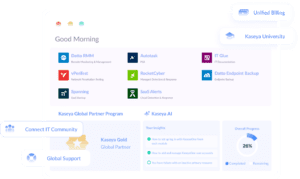
Kaseya’s Unified Cyber Resilience Portal, launched at Kaseya Connect 2026, consolidates all of this into a single integrated management interface. It unifies on-premises, SaaS, endpoint, and cloud backup management, eliminating the tool sprawl that forces technicians to manage recovery across disconnected vendors. Powered by Kaseya Intelligence, it delivers AI-driven screenshot verification with greater than 99.9% accuracy, connected recovery workflows with intelligent prioritization, and compliance coverage including FIPS capabilities and FedRAMP readiness. Azure Files support is generally available now; Agentless Hyper-V backup arrives June 2026.
For MSPs, the portal means a single view across every client environment, with Kaseya Intelligence surfacing the most critical issues rather than leaving technicians to triage across multiple dashboards.
BCDR for MSPs: Protecting Clients and Differentiating Services
Most SMB clients have inadequate BCDR. They may have backup of some kind, but few have documented recovery plans, tested procedures, or technology capable of meeting their actual recovery requirements. This creates both a protection gap and a commercial opportunity.
MSPs that deliver BCDR as a managed service, with documented RTO/RPO commitments, regular recovery testing, and the technology to actually deliver instant or rapid recovery, are providing substantially more value than those delivering backup as a commodity.
The commercial framing is straightforward: what does an hour of downtime cost your client? What does a day? What does an unrecoverable data loss event cost? These are not hypothetical numbers. They’re calculable from BIA data. An MSP that conducts a BIA for each client, quantifies the cost of downtime, and shows how BCDR investment compares to that cost is having a different kind of business conversation than one quoting backup storage prices.
Datto’s BCDR portfolio, including SIRIS for on-premises and hybrid environments and SaaS Protection for SaaS data, provides MSPs with the technology to deliver genuine recovery capability across all environments clients use. The Unified Cyber Resilience Portal brings management of all of these environments into a single interface. Explore Datto BCDR for MSPs.
Key Takeaways
- Business continuity keeps operations running during a disruption. Disaster recovery restores IT systems after one. Both are required for comprehensive resilience.
- RTO and RPO are the quantitative requirements that every BCDR technology decision should be measured against, determining which systems need what level of recovery capability.
- A Business Impact Analysis, mapping critical functions to IT dependencies and quantifying the cost of downtime, is the foundation of evidence-based BCDR investment and the most persuasive MSP sales document available.
- Testing is the most critical and most neglected element. Untested plans deliver false confidence, and most organizations discover plan gaps during actual incidents rather than exercises.
- Kaseya’s Unified Cyber Resilience solutions consolidates on-premises, SaaS, endpoint, and cloud backup management into a single interface powered by Kaseya Intelligence, with AI-driven verification at greater than 99.9% accuracy.